Understanding the core mechanics of Cross The Ages is the first step to outsmarting your opponents. Here we break down the fundamental rules and systems – from capturing cards to harnessing elemental powers – and share tips on how to master them.
Board Control and Winning Conditions
In Cross The Ages, board control is king. Both players share a 4×4 board of 16 cells, and you can place a card on any empty cell (no designated sides). To win, you need to accumulate points by controlling cards on that board. The primary win conditions are: be the first to reach a given number of points (e.g. 55, 65, etc.) or have the higher score once all 16 cells are filled. Note, there is also a timer – if your opponent runs out of their 5-minute time bank, you win by default.
Points are earned in two main ways:
- capturing enemy cards (2 points each) and
- maintaining trinity combos (explained below, worth 1 point per involved card each turn).
Unlike many TCGs, there’s no concept of reducing an opponent’s life total – it’s all about the board and the score.
Capturing Cards – The Basics
You capture an opponent’s card by placing one of yours adjacent to it (horizontally or vertically). When you do this, an attack automatically initiates, comparing your card’s power against the enemy card’s power. If your card’s power (after any bonuses) is higher, the enemy card flips and comes under your control. If not, the capture fails and the opponent retains their card. Adjacency is key – you can place cards freely on empty cells that aren’t adjacent to the enemy, but those placements won’t capture anything (they might still be strategic for later moves though). Because the board is small, every placement creates new adjacency relationships, so think ahead about which enemy cards you’re exposing yourself to or setting up to capture.
Multi-Captures and Chains
Positioning a single card can potentially flip several of your opponent’s cards in one turn. If you place a card such that it’s adjacent to multiple enemy cards, it will attempt to capture all of them simultaneously.
Successful captures can even chain – when an enemy card is flipped to your side, it immediately tries to capture any of its remaining adjacent enemy cards too. This chain reaction continues up to a limit (each card has a “chain counter” limiting how many extra captures it can trigger). Mastering this means you can orchestrate huge swings in board control: for example, capture a cluster of weak enemy cards in one go. To utilize chains, play cards when your opponent’s cards are clumped together – a well-placed attack in the middle of several enemy cards could cascade through them if your power is sufficient.
Tip: Pay attention to a card’s chain value if known, and remember that capturing even one card can snowball. Likewise, be mindful of how you place your own cards – if you bunch your cards, one strong enemy play could flip them all. Sometimes it’s wise to leave “gaps” to prevent an easy multi-capture.
Elements, Advantages and the Heptagram
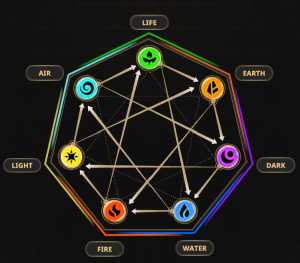
Heptagram of Elements
The Heptagram of Elements in Cross The Ages. Green lines indicate which element is stronger (+100 Power) against another, while red lines show weaknesses (-100 Power). Purple lines connect elements that form Affinities (two-card combos) and Trinities (three-card combos), granting bonus power and points
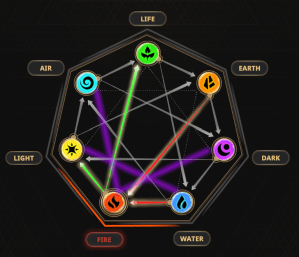
Fire trumps Light and Life
(see the green arrows)
Earth and Water trump Fire
(see the red arrows)
Every card in CTA belongs to one of seven elements: Life, Earth, Darkness, Water, Fire, Light, or Air. This elemental alignment is more than just flavour – it’s central to strategy. The relationships between elements are shown on the in-game Heptagram chart (a seven-pointed diagram) which you can reference during play. Here’s how elements work:
- Elemental Advantage: Each element is strong against two elements and weak against two other. If you play a card with an element that is superior to the enemy card’s element, your card gains +100 power during that capture attempt. Conversely, if your element is at a disadvantage, your card loses 100 power for that attack.
For example, Fire trumps Light and Life (Fire gets +100 when attacking Light or Life), but Fire is weak to Water and Earth (Fire suffers -100 when attacked by Water or Earth). These advantage lines are color-coded on the Heptagram (green for advantage, red for weakness).
- Field Element Bonus: Apart from cards’ elements, the battlefield itself can have elemental properties. Certain Field cards (a type of card in your deck) can impose an element on the board or an area, granting further bonuses. For instance, if a “Nature field” effect is active, all Nature cards played might receive a power boost (e.g., +50 power) while that field persists. Field cards do not occupy a board cell and playing a field card does not end your turn, meaning you can play a field to enhance your board, then immediately play a battle card. Use this to your advantage: drop a field that strengthens your element right before you make a crucial capture attempt, or play a field that weakens the opponent’s favored element to tilt future exchanges in your favour.
Mastery tip: Always check the Heptagram before initiating a capture. Even a lower-power card can flip a stronger one if it has the elemental edge. Conversely, avoid attacking when your element is at a known disadvantage unless you’ve boosted your power enough to compensate.
Affinities and Trinities (Elemental Combos)
Cross The Ages rewards clever positioning of different elements through the Affinity and Trinity system.
- Affinities are power boosts you get for placing certain elements adjacent to each other (when those cards are under your control). If two allied cards have a compatible elemental relationship (often depicted as a purple line on the Heptagram), each of those cards gets +100 power as long as they’re side by side. This is essentially a buddy bonus for two cards. For example, placing a Fire card next to an Air card creates an affinity that sparks a +100 power boost on both cards. It doesn’t capture anything by itself, but it makes those cards harder for your opponent to capture in future. You’ll notice a visual effect (like lightning between cards) when an affinity is active.
- A Trinity takes this concept further. A Trinity is achieved when you control three cards on the board whose elements form a sequence on the Heptagram. In practice, that means three specific different elements all in play on your side, each adjacent appropriately (for example, Air, Nature, and Earth might form one such trio if those elements are linked in the lore). When you have a Trinity, each of those three cards gains +100 power (just like affinities) and you score extra points each turn for maintaining that trio. Specifically, a Trinity yields 1 point per card per turn under your control, which is 3 points per full Trinity per turn. Those points accumulate rapidly, providing a strong incentive to set up and protect these combinations.
Mastering Affinities/Trinities
A big part of high-level play is planning your card placements to either create these combos for yourself or prevent your opponent from doing so. If you have two cards that could form an affinity, consider playing them adjacent to immediately boost their strength – this could be the difference between your card surviving an enemy’s attack or not. For a Trinity, you often have to think a few moves ahead: you might deliberately include cards of complementary elements in your deck (more on deck building next post) so that during the game you can aim to get those three onto the board simultaneously.
When you do form a Trinity, defend it!
Those cards become point-generators every turn, so your opponent will likely try to break it by capturing one of them. Anticipate this and be ready to reinforce or recapture if needed. On the flip side, if your opponent forms a Trinity, make it your priority to disrupt it – even if it means using a slightly suboptimal move to flip one of the trio, because leaving a Trinity unchecked can swing the score in their favour quickly.
Turn Structure and Tempo
Each turn in Cross The Ages gives you some flexibility. On your turn, you can do up to three types of actions in any order:
- discard a card from your hand to draw a new one (mulligan),
- play a field card, and
- play a battle card.
You can even do all three in one turn if you have the right cards – for example, discard something you don’t need (this does not end your turn), then play a field card (also does not end turn), and finally play a battle card which does end your turn. Understanding this sequence lets you optimize your plays. If you have a field card, you almost always want to use it before your battle card since it’s essentially a free bonus action. Don’t forget you also have a one-time option each turn to swap out a card from your hand – use that to fish for your power cards or needed element if your current hand isn’t ideal.
The game uses an active timer system: each player has 5 minutes total for their moves, with a soft cap around 90 seconds per individual turn.
Time management is a core mechanic too – playing swiftly puts pressure on your opponent. If you notice your opponent taking long on each decision, you could try maintaining a complex board state that forces them to think (especially if you’re ahead on points), possibly running their clock down. However, be careful not to let your own timer tick away in a complicated combo.
Tip: Practise the flow of actions (discard -> field -> battle) so it becomes second nature even under pressure.
Leader Abilities
When building your deck, you designate one card as your Leader. This leader is guaranteed to be in your starting draw and, importantly, carries a special ability that can be used in games. Leaders in Cross The Ages are not immortal avatars as in some other games. If your leader card is captured, you do not automatically lose – the game goes on. However, the leader’s special ability can significantly influence the match, so using it (and timing it well) is critical. Leader abilities vary (and any card can be chosen to be leader with whatever ability you assign to it during deck construction), so we won’t go into specific abilities here.
But as a rule of thumb: don’t forget to use your leader ability! New players sometimes get tunnel vision on playing cards and forget that their leader’s power might turn the tide – whether it’s a buff, an extra attack, a card steal, etc. Leader abilities often can combo with other actions (for example, some can be used in the same turn as playing a card, similar to field cards not ending the turn). Mastery of core mechanics includes knowing when to fire off your leader’s ability – whether to secure a crucial capture or to save a vulnerable card.
Core Mechanics Quick Tips
- Plan Adjacent Attacks: Try to play cards so they touch multiple enemy cards. If your card’s power is high enough, you could capture several in one turn via a chain reaction. Turning a single placement into a multi-capture is how you snowball a lead.
- Leverage Elemental Advantages: Always consider elements before attacking. If you have a card at a -100 power elemental disadvantage, maybe play a different card or a field first. Conversely, take advantage of +100 boosts when you can – a weaker card can topple a stronger foe with the right element.
- Use Field Cards Wisely: Since playing a field card doesn’t end your turn, use them to set up big plays. For example, drop a field that boosts Water element, then play your Water creature to capture an enemy with the bonus. Fields can also remove or counter enemy field effects, so respond in kind if your opponent alters the board.
- Form (and Break) Affinities: Keep an eye on potential affinities. Placing two compatible elements side by side gives both a +100 power buff – that might be just enough to fend off an enemy capture. If your opponent has two cards glowing with an affinity (you’ll see visual sparks), remember they’re tougher to capture until separated.
- Trinities = Ongoing Points: If you manage to get a Trinity, you’ll earn 3 extra points every turn it stays active. This can win games outright. Aim to build one if your deck elements allow, but be ready to protect it. Likewise, never ignore an enemy Trinity; breaking it should become your immediate objective to stop their point gain.
Master these fundamentals and you’ll already be a formidable CTA player. Next, we’ll look at how to assemble a great deck to put these mechanics into practice.
 crosstheages.blog
Response
[…] discussed chain captures in the mechanics post, but tactically, you can plan for chains by considering the sequence of captures. Let’s say an […]
LikeLike